Key Takeaways
- A Security Agency is a licensed organisation providing trained personnel and risk-management services, vital for modern protection needs.
- They offer services beyond guarding, including risk assessment, visitor management, emergency response, and layered supervision.
- Hiring a security agency reduces legal liabilities and provides trained manpower, ensuring continuity and professional SOPs.
- Increased urban crime and legal requirements make a Security Agency essential for maintaining safety and compliance.
- Choosing the right agency involves finding one that is licensed, has clear training programs, and prioritises accountability over price.
Estimated reading time: 7 minutes
In today’s unpredictable world, security is no longer a luxury or a secondary consideration. It has become a basic requirement for businesses, residential complexes, institutions, and even events of all sizes. Choosing the right security agency can ensure you have the essential protection needed. Yet, when people hear the term security, many still imagine a lone guard sitting at a gate with a register and a whistle. That image is outdated—and dangerously misleading.
A modern Security Agency is far more than just manpower. It is a structured, regulated, and trained organization designed to prevent loss, manage risk, deter crime, and respond effectively to emergencies. Whether you run a corporate office, a factory, a hospital, a hotel, or a housing society, understanding what a security agency actually does—and why you need one—can make the difference between controlled safety and avoidable chaos.
This article takes a practical, ground-level look at what a security agency really is, how it functions, and why relying on one is no longer optional in today’s environment.
What Exactly Is a Security Agency?
A Security Agency is a licensed professional organization that provides trained security personnel and risk-management services to protect people, property, assets, and information. Unlike informal or untrained guards, a legitimate security agency operates within a legal and operational framework that includes recruitment standards, training protocols, supervision, compliance, and accountability.
In India, security agencies are regulated under laws such as the Private Security Agencies Regulation Act (PSARA). This means a compliant agency must meet government-mandated requirements related to background verification, training hours, uniform standards, and operational conduct.
In simple terms, when you hire a security agency, you are not just hiring guards—you are hiring a system.
The Evolution of Security Agencies
Security agencies did not start the way they operate today. In the past, most businesses relied on chowkidars or watchmen—often hired individually, with no training, no accountability, and no backup.
As cities expanded, crime patterns became more sophisticated, and legal liabilities increased, this informal system started failing. Businesses realized that security had to be:
- Organized
- Accountable
- Professionally managed
- Legally compliant
This led to the rise of structured security companies that could recruit at scale, train consistently, supervise effectively, and replace manpower instantly when required.
Today’s security agency is closer to a risk-management partner than a manpower vendor.
What Services Does a Security Agency Provide?
Many people underestimate the scope of services offered by a professional security firm. Below are some of the core functions that go far beyond “standing guard.”
1. Manned Guarding Services
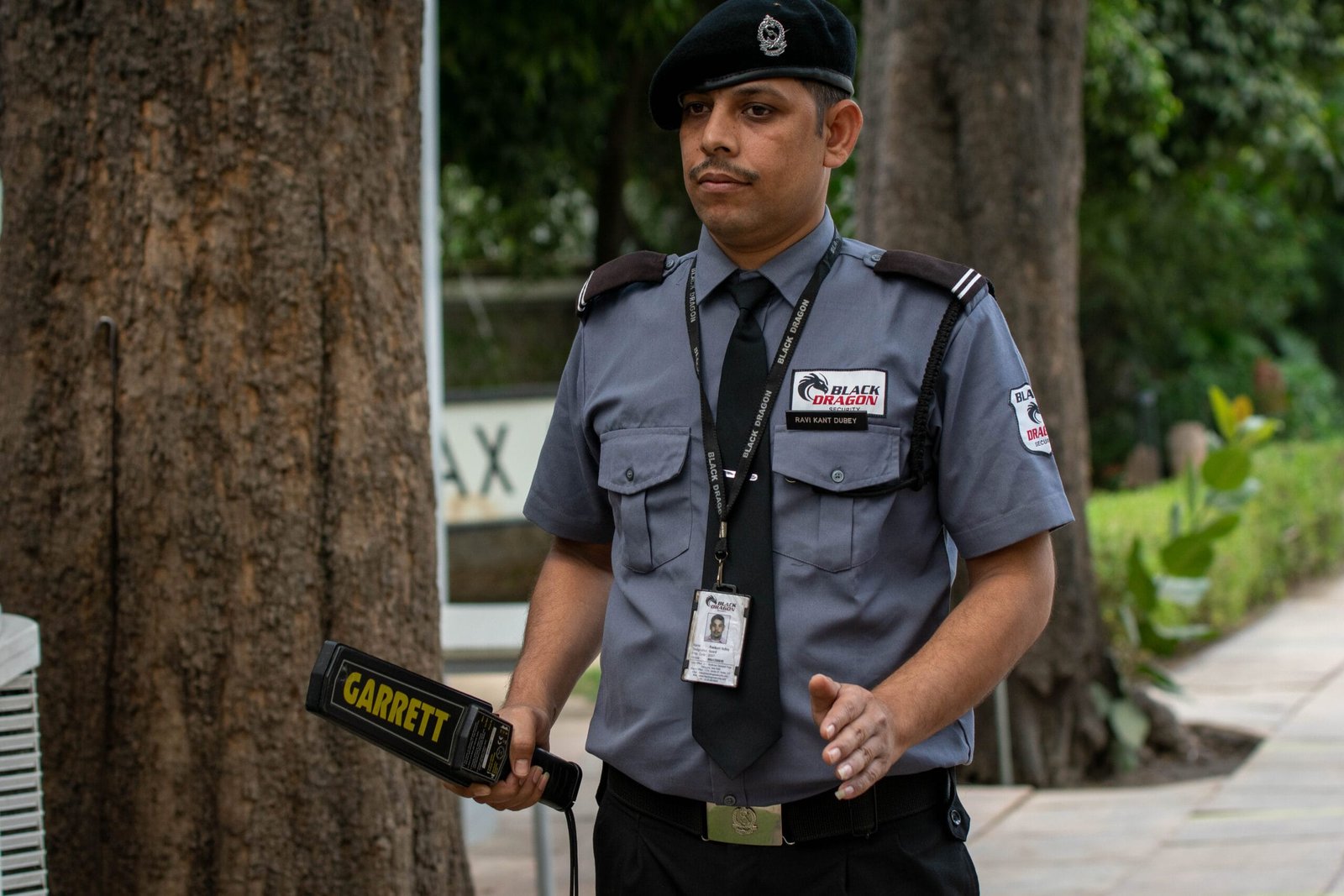
This is the most visible role of a security agency. Trained guards are deployed at entry points, perimeters, sensitive zones, and high-traffic areas. However, their role is not passive.
A trained guard is responsible for:
- Access control and visitor management
- Monitoring suspicious behavior
- Enforcing site rules and SOPs
- Conducting patrols and checks
- Acting as the first responder during emergencies
Unlike untrained individuals, agency guards are taught how to observe, report, and react correctly.
2. Risk Assessment and Site Evaluation
A good security company does not blindly deploy guards. Before deployment, professionals assess the site for vulnerabilities such as:
- Blind spots
- Poor lighting
- Uncontrolled entry/exit points
- High-risk zones
- Fire and safety gaps
Based on this assessment, the agency designs a customized security plan. This planning is what separates a professional security agency from a cheap guard supplier.
3. Visitor and Access Management
In offices, hospitals, factories, and residential societies, visitor mismanagement is one of the biggest security risks. A security agency designs systems for:
- Visitor logging
- ID verification
- Badge issuance
- Vehicle checks
- Material movement tracking
These processes reduce theft, unauthorized access, and internal misuse.
4. Emergency Handling and Crisis Response
Security incidents rarely announce themselves. Fires, medical emergencies, theft attempts, labor unrest, and accidents require calm, trained responses.
Security agency personnel are trained to:
- Follow emergency SOPs
- Coordinate with police, fire, and medical services
- Control crowds
- Secure the site during chaos
- Protect lives first, then assets
This preparedness cannot be improvised at the moment of crisis.
5. Supervision, Monitoring, and Accountability
One major advantage of a security agency is layered supervision. Guards are not left on their own. Supervisors conduct:
- Surprise checks
- Attendance verification
- Performance audits
- SOP compliance reviews
If a guard fails, the responsibility lies with the agency—not the client.
Why Hiring a Security Agency Is Better Than Hiring Guards Directly
Many organizations still believe hiring guards directly saves money. In reality, it often costs more—financially and legally.
1. Legal and Compliance Protection
When you hire guards directly, you become responsible for:
- Minimum wages
- ESI and PF
- Overtime payments
- Leave management
- Labor disputes
A licensed security agency absorbs these liabilities. If an issue arises, the agency—not you—is accountable. read more
2. Trained Manpower Instead of Trial and Error
Training guards requires time, money, and expertise. A security agency already has structured training programs covering:
- Physical security
- Fire safety
- First aid
- Vehicle search
- Soft skills
- Legal awareness
You receive ready-to-deploy personnel without running your own training operation.
3. Replacement and Continuity
What happens when a guard does not show up?
With direct hiring, your operations suffer. With a security agency, replacements are arranged immediately. Continuity is guaranteed.
4. Professional SOPs and Documentation
A security agency works with documented SOPs, incident reports, visitor logs, patrol records, and compliance registers. This documentation becomes crucial during audits, insurance claims, or legal disputes.
Why Businesses Need a Security Agency Today More Than Ever
Modern threats are different from those of the past. Theft today may not be physical—it could be data theft, inventory manipulation, or internal sabotage.
Here’s why a security agency is no longer optional:
Rising Urban Crime and Internal Threats
Many losses happen internally—by staff, vendors, or contractors. A visible, alert security presence discourages misconduct before it happens.read more
Increased Legal Liability
If an incident occurs on your premises, you may be held responsible. A security agency demonstrates due diligence, which can significantly reduce legal exposure.
Brand Image and Trust
Security affects perception. Clients, employees, and visitors feel safer in well-secured premises. This trust directly impacts brand reputation.
Insurance and Compliance Requirements
Many insurers now require documented security measures. A professional security agency helps meet these conditions, often reducing insurance premiums.
Security Agency vs Technology: Why Human Presence Still Matters
CCTV cameras, access control systems, and alarms are valuable—but they are tools, not solutions.
Technology cannot:
- Judge intent
- De-escalate conflicts
- Make ethical decisions
- Handle unpredictable human behavior
A trained security guard supported by technology offers the best results. Their role is to integrate human intelligence with technological tools, not replace one with the other. read more
How to Identify a Reliable Security Agency
Not all agencies are equal. Choosing the wrong one can be worse than having none.
Look for:
- Valid licensing and compliance
- Transparent pricing
- Structured training programs
- Clear supervision hierarchy
- Written SOPs
- Willingness to conduct audits and reviews
Avoid agencies that compete only on price. Cheap security often becomes expensive later.read more
Common Misconceptions About Security Agencies
“Security is only needed after an incident.”
Security exists to prevent incidents, not react to them.
“Cameras are enough.”
Cameras record incidents; guards prevent them.
“All guards are the same.”
Training, discipline, and supervision make a huge difference.
The Long-Term Value of a Professional Security Agency
Security should be viewed as an investment, not a cost. The return comes in the form of:
- Reduced losses
- Fewer disruptions
- Better compliance
- Improved workplace confidence
- Stronger operational discipline
Over time, these benefits far outweigh the monthly expense.
Final Thoughts
A Security Agency is not just a supplier of guards. It is a structured safety partner that protects your people, assets, operations, and reputation. In an era where risks are complex and consequences are severe, relying on informal or untrained security is a gamble no serious organization should take.
Whether you manage a small office or a large enterprise, the right security service brings order where there could be chaos, confidence where there could be fear, and control where there could be loss.
Security is not about reacting to problems—it is about ensuring they never happen.